The Anatomy of Product Experience Workshop
Better products begin with understanding the experience.
-
A Good Product Can Still Fail
The problem isn't always the product itself. It may be how the experience unfolds.
Designing Product Experience gives you a practical framework for understanding the full journey: from the expectations people bring to a product, through the sensory experience of consumption, to the memories that shape future decisions.
Drawing on psychology, neuroscience, sensory science and behavioural research, you'll learn to diagnose where product experience breaks down, identify opportunities for improvement and translate scientific insight into commercially meaningful action.
-
Flavour is a Timeline
Sensory teams evaluate product properties. Marketing shapes expectations. Brand teams establish associations. Consumer research measures responses. Commercial teams track performance.
Each discipline provides valuable information, but the experience connecting them is rarely examined as a whole.
A product's value emerges through the interaction between its physical properties, the person experiencing it, and the context of that experience. Understanding those interactions creates opportunities to make better decisions and focus resources efficiently.
-
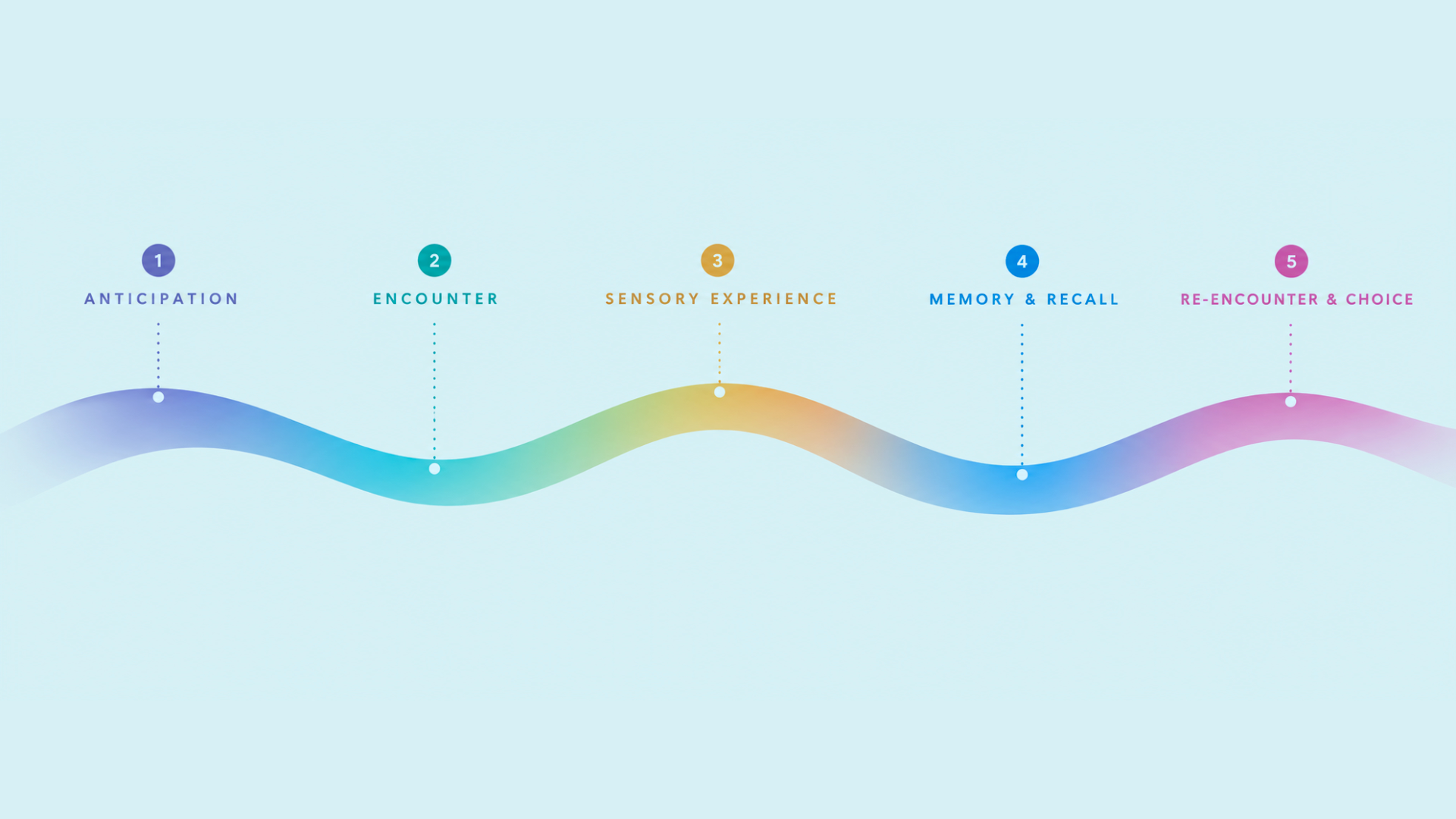
Our 5 Stages of Product Experience
1. Prediction
Understand how prior experience, expectations, packaging, price, positioning, and context influence what people anticipate and how they approach a product.
2. Encounter
Explore how people interpret product signals, understand its purpose, and decide whether it is relevant to their needs or occasion.
3. Sensory experience
Investigate how taste, smell, texture and other sensory inputs combine with attention, context and interpretation to shape the experience.
4. Memory and recall
Discover how experiences are encoded, retained and reconstructed, and why the experience people remember may differ from the one they had.
5. Re-encounter and choice
Understand how recognition, remembered value, learned associations and expectations influence subsequent selection, consumption and recommendation.
“What made Kami’s contribution particularly memorable was his ability to bridge rigorous science with creative thinking and a lot of humor. He invited us to reconsider fundamental aspects of flavour perception, including the influence of airflow and turbulence within the nasal cavity on how flavour is experienced.”
Andrea Albertino
Immediate Past President - British Society of Flavourists

-
Who Is This Workshop For?
Product experience does not belong to a single department. It develops at the intersection of product properties, consumer expectations, sensory perception, brand meaning and behaviour.. The workshop is designed for cross-functional food and beverage teams, including:
Product development and innovation
Understand how changes to product properties influence the wider experience, and identify opportunities beyond reformulation alone.Sensory and consumer research
Connect sensory findings to consumer interpretation, memory and behaviour, and improve the questions your research is designed to answer.Brand and marketing
Understand how messaging, contextual signals, and brand associations shape expectations and influence the experience.Insight and commercial teams
Connect consumer responses to plausible mechanisms, improve the quality of product decisions and identify where further investigation can reduce uncertainty.Leadership and innovation management
Give teams a common framework for prioritising product opportunities, evaluating evidence and allocating resources.“Kami was asking questions that had bothered me for some time, highlighting gaps in our approach to product development and flavour sensory analysis. Across the sector we struggle to balance the depth of analysis, sensory and chemical, with cost and time pressures. Kami was putting these thoughts together and offering solutions and guardrails.”
Craig Duckham (PhD FRSB FIFST)
Director CD R&D Consultancy Services